Beyond Visibility
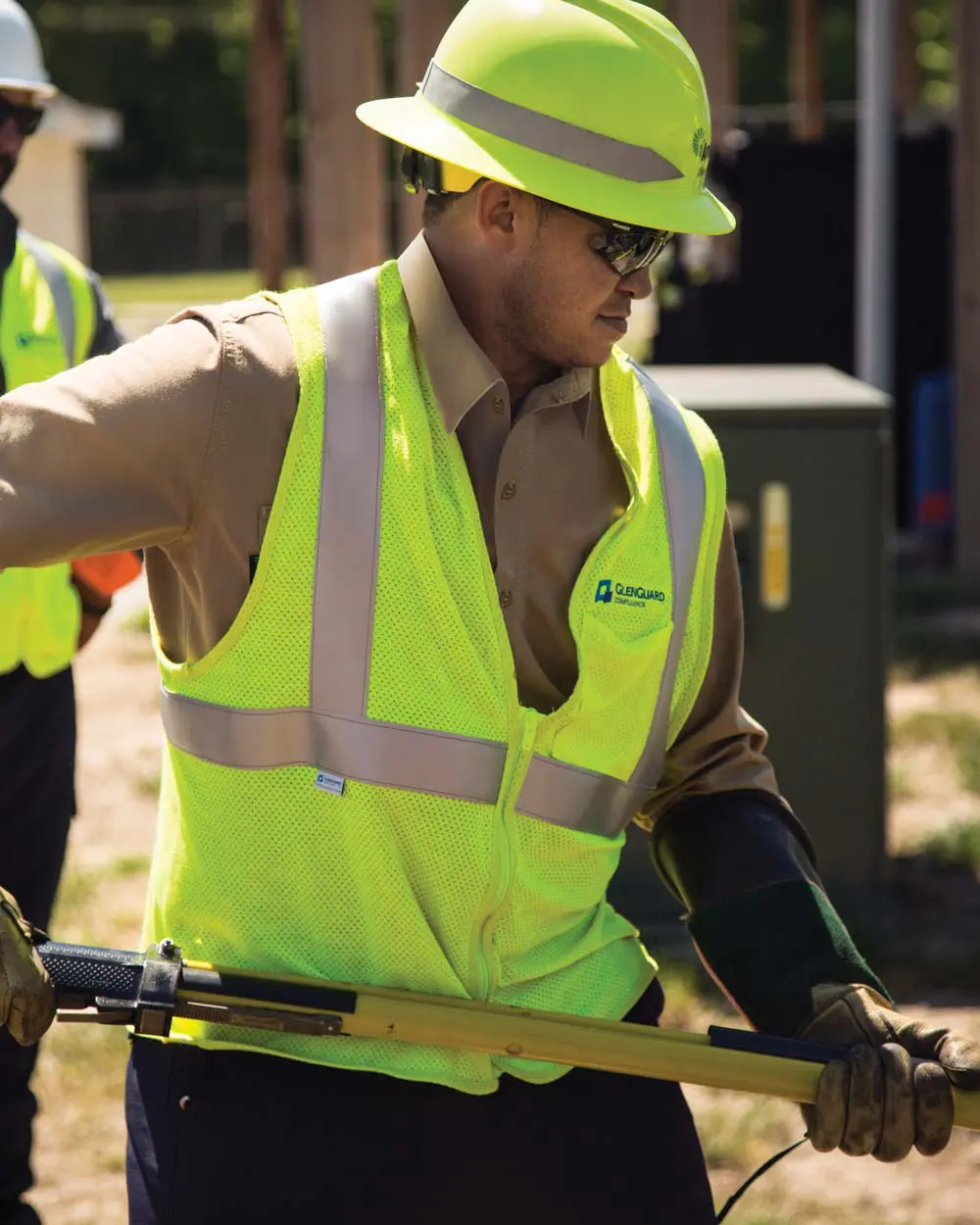
Beyond Visibility Specifying FR Hi-Vis for Multi-Hazard Work Environments
Executive Summary
High-visibility clothing has to do more when workers also face arc-flash, flash-fire, or static-related hazards. In those environments, the hi-vis layer becomes part of the protective clothing system.
A garment can meet the visibility requirements for the job without providing the thermal protection the worker needs. Flame resistance alone also does not establish an arc rating. Safety teams therefore need to identify each hazard the worker may encounter and translate those exposures into specific clothing requirements.
The assessment should reflect the work as it is actually performed. Tasks may change during a shift, weather can add outer layers, and other PPE can affect fit and coverage. Those conditions can change the performance of the clothing system even when the individual garments meet their technical requirements.
The specification should account for that complete system. Safety teams need to verify the required high-visibility performance, arc rating, flash-fire protection, or electrostatic properties for the job, then confirm that the selected garments remain compatible when worn together.
The result is a more defensible FR hi-vis program built around the actual exposure rather than a product label. The right garment must provide the required protection on paper and continue to support that protection under the conditions workers face in the field.
When Visibility Is Only One Hazard
The problem begins when a worker needs the hi-vis garment to do more than make them visible.
ANSI/ISEA 107-2020 establishes criteria for high-visibility safety apparel and designates conforming garments by Type, based on the expected use setting, and Performance Class, based on garment design and the amount of visible material.[1] Those requirements address conspicuity. They do not establish protection against other hazards.
Consider a utility worker who spends part of the day beside vehicle traffic and later performs work with an electric-arc exposure. The worker may need high-visibility apparel for the first condition and protective clothing that addresses the electrical exposure for the second.
For electric power work covered by OSHA 1910.269, employers must identify employees exposed to flame or electric-arc hazards and estimate incident energy for employees exposed to electric arcs. The rule also establishes conditions where protective clothing must be flame resistant or arc rated.[2]
In that situation, the hi-vis layer becomes part of the protective clothing system. The same issue arises when workers need to remain visible in an environment with a credible flash-fire hazard.
Many workers who wear hi-vis do not need FR or arc-rated clothing. Where those hazards are present, however, meeting the visibility requirement is only one part of the clothing decision.
Build the Specification Around the Work
Once multiple hazards are possible, the next step is to define the work before deciding what the garment needs to provide.
OSHA’s nonmandatory PPE-selection guidance recommends considering the possibility of exposure to several hazards at the same time, then comparing those hazards with the capabilities of available protective equipment.[3] Specific standards may add further requirements. OSHA 1910.269, for example, requires employers to identify flame and electric-arc exposures for covered electric power work.[2]
For an FR hi-vis program, that means looking beyond the job title.
A “maintenance technician,” “lineworker,” or “refinery operator” may move through several exposure conditions during a single shift. A worker might start in an equipment yard, work beside vehicle traffic, enter an electrical area, and later add rainwear as conditions change.
The key is to identify where those hazards overlap. A utility crew may need conspicuity while setting up beside a roadway, then transition into work with an electric-arc exposure. At a refinery or petrochemical site, workers may need visibility around mobile equipment while performing tasks where flash fire is a credible concern.
Environmental conditions can change the clothing system too. Cold or wet weather may add outer layers, while hot conditions can affect what workers can tolerate over a full shift. Harnesses and other PPE may also change how the garment fits and stays positioned.
That means the safety team needs to look beyond the hazard itself and understand how the clothing will actually be worn during the work. Before selecting an FR hi-vis option, answer a few basic questions:
- What task is being performed?
- Which hazards exist during that task?
- Which hazards can occur at the same time?
- What clothing or PPE will be worn over or under the hi-vis garment?
- Will weather or seasonal conditions change the clothing system?
- Does the worker move between different exposure conditions during the shift?
Those answers clarify what the clothing system needs to protect against and the conditions it needs to work under. From there, the safety team can identify the specific performance requirements that apply.
Translate the Hazard Assessment Into Clothing Requirements
With the task and overlapping exposures defined, the safety team can translate the hazard assessment into measurable clothing requirements.
Labels such as “FR hi-vis” or “multi-hazard” are not specific enough for that decision. Each hazard creates a different performance question. The table below separates those questions by showing what the clothing needs to provide and what the safety team should verify before selecting a garment.
| Hazard or Exposure | What the Clothing Needs to Provide | What the Safety Team Should Verify |
| Low visibility | Appropriate conspicuity for the work environment | Applicable ANSI/ISEA 107 Type and Performance Class, garment design, and finished-garment documentation |
| Electric arc | Thermal protection appropriate to the assessed arc exposure | Arc rating per ASTM F1506, applicable garment documentation, and compatibility with the rest of the arc-rated clothing system |
| Flash fire | FR performance appropriate to the identified short-duration thermal exposure | Applicable NFPA 2112 performance or certification and finished-garment construction |
| Static-related ignition concern | Specified electrostatic performance where the hazard assessment supports its use | Test method or property claimed, intended use, and how the garment fits within the site’s broader static-control strategy |
This framework provides high-level decision points. The details differ by hazard, so each requirement needs to be evaluated against the standard, rating, or performance information that applies to it.
High-Visibility Performance
ANSI/ISEA 107 addresses the visibility function of the garment. The appropriate Type and Performance Class should match the work environment and tasks.[1]
Safety teams should verify the finished garment rather than assume fluorescent fabric or reflective tape automatically makes a vest compliant.
How the garment will be worn matters too. If another layer covers the hi-vis garment during the work, the visibility performance established by the original selection may no longer be available to the worker.
Arc-Flash Protection
Where an electric-arc hazard exists, the clothing system needs to match the applicable electrical hazard assessment.
Arc-rated and flame-resistant are related terms, but they are not interchangeable. All arc-rated fabric is flame resistant, but flame resistance alone does not establish an arc rating.[8]
The arc rating gives the safety team a performance value that can be compared with the exposure. ASTM F1506-25 establishes requirements for flame-resistant and electric arc-rated protective clothing, including arc rating, flame resistance, garment construction and performance, and labeling.[4]
For electric power work covered by OSHA 1910.269, when estimated incident heat energy exceeds 2.0 cal/cm², employees generally must wear protective clothing and other protective equipment with an arc rating at least equal to that estimated exposure.[2]
The question, then, is not simply whether the garment is FR. The safety team needs to verify that its arc rating is appropriate for the exposure.
Flash-Fire Protection
Flash-fire exposure requires a separate performance check.
NFPA 2112 addresses flame-resistant garments intended to protect industrial personnel against short-duration thermal exposures from fire.[5] Where that hazard is present, safety teams should verify the applicable flash-fire performance rather than infer suitability from another rating or designation.
The finished garment matters as much as the fabric specification. Seams, closures, reflective components, and mesh or ventilation areas are all part of the garment workers actually wear. The complete construction needs to maintain the required protective performance.
Static-Related Performance
Where the hazard assessment identifies a credible electrostatic ignition concern, the clothing may also need to provide static-dissipative performance.
EN 1149 provides the framework for evaluating the electrostatic properties of protective clothing. EN 1149-3 specifies test methods for measuring how effectively garment materials dissipate electrostatic charge, while EN 1149-5 establishes material performance and design requirements for electrostatic dissipative protective clothing.[9]
For the safety team, the key question is whether the clothing has been evaluated for the static-dissipative performance required for the application. That performance should still be considered within the site’s broader controls for electrostatic ignition hazards.
By working through each requirement separately, the safety team ends up with defined performance criteria that can be compared with the exact garment under consideration.
Evaluate the Complete Clothing System
Individual ratings tell only part of the story. Once the required performance has been defined, the safety team needs to evaluate how the garments work together when the employee is dressed for the job.
Start with the outermost layer during the exposure. A worker may have an appropriately selected AR/FR shirt, then add a standard hi-vis vest, jacket, or rain shell as conditions change. If those garments were selected independently, the final clothing system may no longer reflect the original hazard assessment.
For electric power work covered by OSHA 1910.269, Appendix E explains why those layers matter. OSHA addresses clothing that could melt, ignite, or continue to burn during an exposure and requires suitable flame-resistant or arc-rated protection under specified conditions.[2][7]
The following areas help safety teams evaluate whether the protection established on paper still holds up when the complete system is worn in the field.
Added Layers
Outerwear selected for warmth, rain protection, or visibility may introduce materials that were never evaluated for the thermal hazard. Seasonal clothing deserves particular attention because jackets, rainwear, or personal layers may not have been part of the original specification.
The safety team should account for those additions before an exposure occurs, not after workers have already created their own layering combinations.
Coverage and Movement
The system also needs to maintain coverage while the employee works. Garments that shift, open, or ride up can change the protection the worker actually receives.
Fit has to hold up through the movements the task requires. Climbing, reaching, driving, harness use, and interaction with other PPE can all affect how the clothing sits on the body.
Comfort and Correct Wear
Comfort becomes a safety issue when it changes how the clothing is worn.
Heat, stiffness, poor fit, or restricted movement may lead workers to unzip garments, remove layers, substitute other clothing, or otherwise alter the system. OSHA’s nonmandatory PPE-selection guidance notes that comfort and fit deserve careful consideration and that continued wear is more likely when protective equipment fits comfortably.[3]
Garment construction belongs in that evaluation. A mesh vest may offer a different balance of airflow and protective performance than a woven construction. The protective requirements come first, but the selected garment also has to remain workable under the conditions where employees will use it.
Maintenance and Serviceability
The clothing system still needs attention after it is issued.
ASTM F1506 establishes defined performance and test requirements for protective clothing within its scope.[4] Those tests help establish product performance, but employers still need to keep issued PPE in reliable condition.[12]
Damage, contamination, loss of visibility, or other deterioration may affect whether a garment should remain in service. The clothing program should account for those changes so the system used in the field continues to match the protection the employer intended.
Verify the Specification Before Full Rollout
Once the complete clothing system has been evaluated, the safety team can move from hazard assessment to product selection. That process should confirm three things: what the garment needs to provide, whether the exact product meets those requirements, and whether it remains workable under representative field conditions.
-
Document the Required Performance
Start by defining the performance the garment needs to provide.
Depending on the hazard assessment, that may include an applicable high-visibility Type and Performance Class, a required arc rating, flash-fire performance, or an electrostatic property. Construction, coverage, and expected outer layers may also need to be defined.
This gives purchasing teams and garment suppliers a clear basis for comparing qualified options.
-
Verify the Exact Product
Compare the requirements identified for the job with the documentation for the specific product being considered.
Fabric styles and constructions can differ within the same product category. Ratings and intended uses can differ as well. Safety teams should verify the actual material and finished garment rather than assume every FR hi-vis option provides equivalent performance.
Trust, but verify. Ask the supplier or distributor for current documentation supporting the product’s claimed ratings, certifications, and compliance with the applicable standards. Depending on the product, that may include certification records, test reports, or other technical documentation.
Technical documentation can confirm specific performance characteristics, but it cannot show how the clothing will function on every worker or during every task. That is where field evaluation becomes important.
-
Validate the Clothing Under Representative Work Conditions
A field evaluation or structured wear trial can identify issues that technical documentation cannot.
A garment may restrict movement when combined with other PPE. Sizing may affect coverage. Changing weather can lead workers to add another layer, while hot conditions may change how the garment is worn.
The trial should reflect the conditions workers are likely to encounter, including representative tasks, required layers, environmental conditions, and other PPE worn with the garment.
Worker preference should not override the protective requirement. The purpose of the field evaluation is to determine whether a qualified clothing option remains workable under the conditions in which employees are expected to use it.
Applying the Framework With GlenGuard FR Hi-Vis
The multi-hazard approach outlined in this paper requires more from a hi-vis garment than visibility alone. Once the required protection is clear, safety teams can compare qualified options based on how well they address the hazards and working conditions identified for the job.
GlenGuard FR Hi-Vis is designed for environments where visibility overlaps with thermal and other hazards.
High visibility with inherent FR and AR performance
GlenGuard FR Hi-Vis combines high-visibility performance with inherent flame resistance for work involving arc-flash and flash-fire exposures.[9] GlenGuard publishes style-specific arc ratings for individual fabrics, giving safety teams specific performance information to compare with the electrical exposure identified for the job.
Woven, mesh, and Anti-Stat options for different work environments
The FR Hi-Vis line includes woven and mesh constructions, giving employers options when considering both required protection and how the garment will be worn in the field.[9]
Where the hazard assessment identifies a need for electrostatic performance, GlenGuard also offers a Hi-Vis Anti-Stat option intended for environments where gas is present and sparks could create a hazard. GlenGuard identifies EN 1149-3 and EN 1149-5 among the electrostatic standards associated with the product.[9] Anti-static performance should remain part of the site’s broader static-control strategy.
Testing and field evaluation beyond the data sheet
GlenGuard reports testing its protective fabrics for conditions relevant to multi-hazard work, including arc flash, flash fire, and industrial laundering.[10]
Technical data can establish how a fabric performs under defined test conditions. Field use adds another question: how does the finished garment work with the tasks, layers, other PPE, and environmental conditions employees actually encounter?
Put the Garment to Work Before a Larger Rollout
GlenGuard’s wear-trial program gives employers an opportunity to evaluate garments made with GlenGuard fabric under representative working conditions.[11]
For safety teams considering a new or revised FR hi-vis program, the process is straightforward: establish the required protection, identify the GlenGuard options that meet those requirements, then evaluate the selected garment in the field before making a broader clothing decision.
Conclusion: Multi-Hazard Protection Depends on the Complete System
FR hi-vis selection starts with the work. A visibility requirement may be straightforward on its own, but the decision changes when the same worker also faces electric-arc, flash-fire, or static-related hazards.
Each exposure needs to be translated into a defined performance requirement. Those requirements then have to remain compatible when the vest, shirt, outerwear, and other PPE are worn together under actual working conditions.
That is where the specification moves beyond individual ratings. A garment may meet the required standard and still create a problem if another layer changes the protection, the system does not maintain coverage during the task, or field conditions lead workers to wear it differently than intended.
A strong FR hi-vis program therefore connects the hazard assessment to the complete clothing system. Safety teams need to verify the performance of the exact garments being considered, account for how those garments will be layered and used, and evaluate qualified options under representative working conditions before a broader rollout.
The goal is not to find one garment that claims to solve every hazard. It is to build a clothing system in which visibility, thermal protection, and any other required performance work together at the point of exposure.
References
- International Safety Equipment Association. ANSI/ISEA 107-2020, American National Standard for High-Visibility Safety Apparel.
- Occupational Safety and Health Administration. 29 CFR 1910.269, Electric Power Generation, Transmission, and Distribution.
- Occupational Safety and Health Administration. Appendix B to Subpart I of Part 1910, Nonmandatory Compliance Guidelines for Hazard Assessment and Personal Protective Equipment Selection.
- ASTM International. ASTM F1506-25, Standard Performance Specification for Flame Resistant and Electric Arc Rated Protective Clothing Worn by Workers Exposed to Flames and Electric Arcs.
- National Fire Protection Association. NFPA 2112, Standard on Flame-Resistant Clothing for Protection of Industrial Personnel Against Short-Duration Thermal Exposures from Fire, 2023 Edition.
- National Fire Protection Association. NFPA 77, Recommended Practice on Static Electricity, 2024 Edition.
- Occupational Safety and Health Administration. Appendix E to 29 CFR 1910.269, Protection From Flames and Electric Arcs.
- National Fire Protection Association. NFPA 70E, Standard for Electrical Safety in the Workplace, 2027 Edition.
- GlenGuard. Flame-Resistant High-Visibility Fabric and Hi-Vis Anti-Stat.
- GlenGuard. Product Testing.
- GlenGuard. Request a Wear Trial.
- Occupational Safety and Health Administration. 29 CFR 1910.132, General Requirements.